A groundbreaking study by the leading economic think tank Center for Research and Communication of the University of Asia and the Pacific (UA&P) and the Association of Licensed Manning Agencies (ALMA Maritime Group) has revealed that the Philippine seafaring industry generated a total ₱1.06 trillion in economic activity in 2024, underscoring its pivotal role in steering the national economy.
The study, titled “The Overseas Seafarers’ Industry Profile, Structure, and Impact on the Philippine Economy,” found that Filipino seafarers contribute about 4% of the country’s Gross Domestic Product (GDP), supporting nearly 400,000 jobs nationwide and providing ₱150.1 billion in household income.
At the heart of this economic wave are foreign shipowners who continue to rely on Filipino seafarers. The employment of Filipino seafarers, researchers emphasized, sustains not just the maritime sector but the broader Philippine economy.
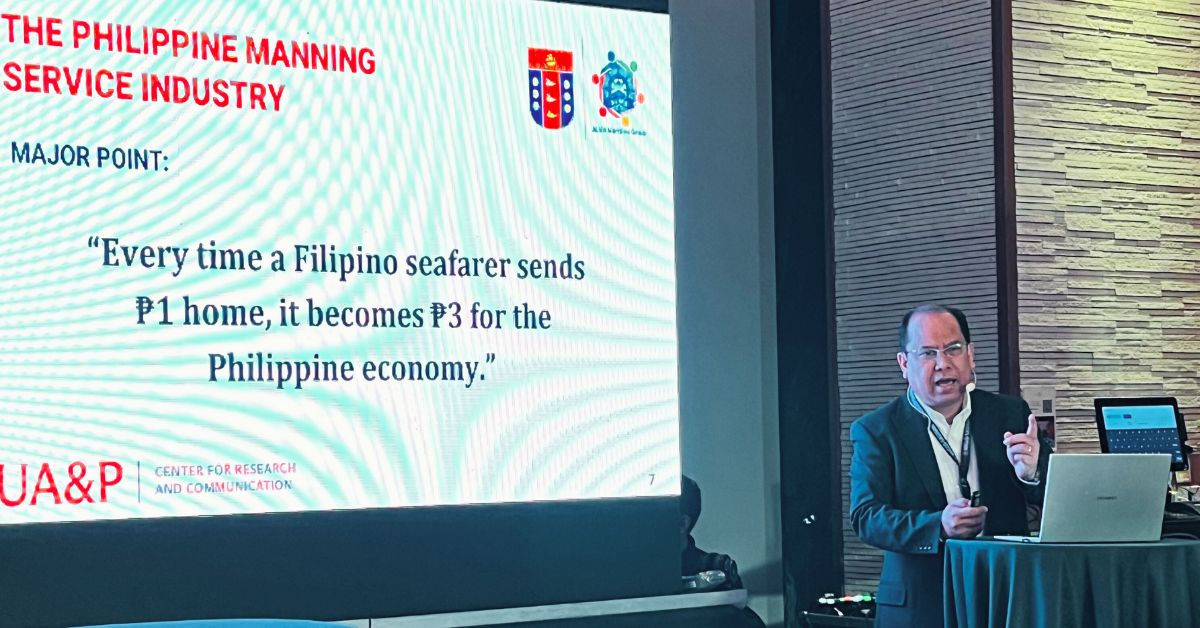
“For every peso a Filipino seafarer sends home, nearly three pesos ripple through the economy,” explained Dr. Winston Padojinog, UA&P Professor of Strategic Management and Industrial Economics and President of the Center for Research and Communication.
In 2024 alone, ₱331.7 billion in direct remittances from seafarers flowed into local communities, driving consumption, business growth, and tax revenues.
“These remittances go through different sectors,” Padojinog said. “There are industry multipliers; for every peso that they spend, it generates more than a peso after it goes through the different industries.”
But beyond remittances, seafaring also creates an extensive domestic ecosystem. The study points out that the industry supports a wide range of onshore jobs — from crewing and logistics to training, insurance, and maritime services — all interconnected with the confidence of shipowners in Filipino manpower.
When Confidence Is Lost, Ships Leave
That confidence, however, should not be taken for granted.
The study revealed that the industry’s economic impact depends heavily on maintaining global confidence in the Philippine seafaring workforce. Should shipowners lose confidence, whether due to policy instability, skills gaps, or global competition, the consequences could be swift and severe.
“In global shipping, when confidence breaks, ships leave,” the study cautioned.
Losing that confidence, researchers noted, would endanger ₱1.06 trillion in economic activity, an estimated 4% of the nation’s GDP, a blow that would ripple across the national economy.
An Industry that Anchors Families and Futures
Behind these numbers are human stories: of parents building homes, children finishing school, and communities thriving on the resilience of maritime families.
“Every Filipino at sea means a Filipino family on land has hope,” the study emphasized. This sentiment captures how the nation’s maritime workforce has shaped the country’s economic and social landscape.
The study underscored that protecting the maritime industry is synonymous with protecting Filipino families and national economic prosperity.
“When we protect the seafaring industry, we protect families, jobs, and 4% of the entire Philippine economy,” Padojinog emphasized.
The study also highlights the importance of reintegrating retiring seafarers and professionals who carry years of technical experience and leadership that can enrich the local maritime sector.
“Remember, our Filipino seafarers are trained. A lot of time and resources have been invested in them. They can easily pass on their experience to others,” the report concluded.
Programs that allow retired seafarers to transition into training, management, or regulatory roles could extend their contributions well beyond their years at sea, strengthening the maritime industry’s future.
The UA&P CRC–ALMA study serves as both a recognition of the Philippine maritime industry’s global contribution and a call to ensure the sustainability of one of the country’s most vital industries.
As the study shows, Filipino seafarers are not just navigating the seas, they are steering the Philippine economy toward growth.
You may access the copy of the study presentation here.
To find out more about CRC, send an email to [email protected], or message +639054280727, or follow us on LinkedIn. You can also find us on Facebook.